Thursday, March 30, 2017

How to Roleplay a Dragon


 Players love facing off against a dragon.

Taking down the ultimate fantasy RPG foe is a real delight.

But you know what’s intimidating? Roleplaying a dragon as the GM.

Dragons are supposed to be fearsome monsters, greedy for gold and completely egotistical. As a GM, trying to inhabit a headspace where you want to kill anyone who intrudes your lair, steal their gold and tell them all how awesome you are while you’re at it can be tough.

We remembered some of our favorite dragons and past entertaining encounters while peering at some old copies of the Monster Manual for advice.

Here are a few things to remember:

Dragons are greedy. Dragons love expanding that treasure hoard. They should be eyeballing the fighter’s magical greatsword and attempting to convince the thief to leave his bag of gold behind. Alternately, he’ll fry those guys with his breath weapon and find those things in the leftover rubble.

Be egotistical. Remember how Smaug kind of toyed with Bilbo? He attempted to intimidate the hobbit by asking questions while showing off his mighty strength. If you’re playing the dragon, he knows he’s the smartest and most powerful person in the room. Play him that way.

Dragons are smart. If you’re the GM, you should know everything that’s going on in your game, including player strengths and weaknesses and the available terrain. Dragons are incredibly intelligent and should be keenly aware of their surroundings. As the GM, allow yourself to metagame a little bit and think of the way the dragon would take out the players.

Make the hoard interesting. Surely, there’s lots of gold that dragon has been piling up. But what magic items has he plucked off wary adventurers who previously infiltrated his lair? What mundane items could he have been picking up? What does the dragon collect? Is the dragon’s wealth made primarily of coins or of items of great value? Does the dragon collect trophies of any kind?

Who works for the dragon? Maybe he’s a solitary creature, but the dragon may also have minions to do his bidding or perhaps a right-hand-man who helps him find new targets for pillaging. He may have slaves working in his lair or a cult that worships him like a god.

What are his tactics? We don’t just mean in battle. The dragon should know his own lair very well (he built it after all) and should know in advance how he’d play out a battle. He’d also know how to play out a conversation. Don’t be afraid to write down lines and/or the direction you’d like to steer the conversation.

What does the dragon find tasty? Maybe he ate a dwarf once and really enjoys the taste, so seeing a bearded party member might get him excited. On the other hand, perhaps an elf once helped the dragon collect a host of treasure, and he now he has a soft spot for elves.

The dragon may not want to fight. Maybe he simply wants to talk. Dragons will defend their lairs and their hoards, but they don’t always necessarily do so with violence. That could involve pitting the players against one of the dragon’s other enemies or sending them up against a foe the dragon thinks they’ll never survive.

Dragons can be lazy. Sitting on a pile of gold can be so much more fun than flying around and breathing fire on everything. A dragon may find it easier to set a load of traps in and around his lair or send someone else to do his bidding. Of course, once those have run their course, a dragon is usually more than happy for a little bloodshed.

Dragons are usually loners. But not always. Once the dragon is taken down players expect that they’ve defeated the boss enemy. But what if there’s another dragon (perhaps its father or big brother or mentor) lurking around somewhere? Or perhaps there was a wizard working in concert with the dragon, and now he’s upset he lost his protection? Surprise your players by continuing the fight after the dragon is gone.

Some dragons can change shape. If your dragon can polymorph, he may have already met the players. Keep that character’s draconic nature a secret. Revealing it at the right time will blow your players away.


Monday, March 20, 2017

Dungeon Crate March Review

March Crate - Image by Justin Andrew Mason

Let’s be honest, the most exciting foe in almost any RPG is the dragon.

Who hasn’t wanted to face down a dragon since reading “The Hobbit?” I remember the first time I ever faced a dragon in a D&D game, we quite literally cheered and danced around the table when we slayed it.

(What we didn’t know at the time was that it was a wyrmling, and its mother dragon was waiting for us in the next encounter.)

And who of us didn’t cheer when Daenerys Targaryen, the mother of dragons, rode her fearsome beasts into battle and wreaked utter havoc on her enemies.

Dragons are the ultimate fantasy monsters. We designed this crate around the scaly, winged beasts and their ultimate master, Daenerys Targaryen, the unburnt, breaker of chains and the mother of dragons herself.

Mother of Dragons Coin
Minted by our pals at Shire Post Mint, these gold coins are completely badass. Depicting Daenerys Targaryen and her three dragons - Drogon, Rhaegal and Viserion - on the front and her pyramid in Meereen on the other, we absolutely love this coin. Mother of dragons and breaker of chains, indeed. Game Masters can hand it out to players as an inspiration token or use it for in-game currency.


 Dragon Miniatures
Need some dragons in your games? We have you covered. These three wyrmling-sized dragons come from Reaper, one of the best manufacturers around. Cast in Reaper’s white Bones plastic, the dragons are easy to paint. (Trust us, we’ve done it.) The dragons are meant to be blue, black and green, but paint them up however you like. If you want to do them up like Daenerys, may we suggest black with red markings, green with bronze markings and creamy white with gold markings?

Breath Weapon Markers
Need to show how a dragon lays down its fire breath? This set of four acrylic templates from Advanced Deployment make it easy to measure exactly what area gets hit with fire (or acid, lightning, poison, cold, etc.). It helps visualize that kind of destruction on the battlefield.

Catapult

Defending against dragons is tough. If they’re circling your castle, maybe it’s best to load up the catapult. Seriously: How cool is this thing? This fully-assembled catapult fits a standard d20, making your rolls a little more exciting. It also fits a coin about the size of a quarter (same size as the Mother of Dragons coin in this month’s box) if you need to make a coin flip. It’s also perfect scale to add to your tabletop. The fine folks at Elderwood Academy made these excellent items.

Monday, March 13, 2017

March updates and info for new subscribers

Greetings Adventurers!

Shipments are going out today!! By the gods we will have these in your hands on time this month. And you will rejoice.
Lots of new subscribers! Wow, you guys are the best. Our facebook and instagram followers are also rapidly growing. Thanks for the help and support.
I will be updating the Digital Crate as well this month. New maps, digital downloads, adventures, character sheets, etc. I will sharpen this end up for you guys. I've been trying to focus on getting a good balance for the physical crate.

Here's a few tips for DC newcomers:
- Cut offs for each month are the 4th, so if you want in, order before then. After the 4th you are batched to the next month.
- Auto renewals hit the 15th of each month. If you have cancel, it will stop auto renewal, but you will still get the crates you pay for.
- If you don't get your crate by the auto renewal and get charged twice without getting the first crate, don't freak out, that just means we are late. Email me and we will get you sorted.
- Send customer service issues to my email at wayne@dungeoncrate.com - try not to hit me up here as it won't be as timely. Email allows me to respond quick and keep track of issues. I'm old.
- Read our website. I spent hours putting together the Dungeon Crate website along with the FAQs. I realize you all are busy doing really important things, but I answer a lot of questions on the site, on here, via email, on our blog, and on our YouTube channel.
- Note that all crates go out at the same time. I ship everything once per month. Not on demand. Don't expect to order today then get a crate in 3 days. We do one shipment per month. That's the subscription model.
- Visit our online store for more or additional items.
http://www.dungeoncrate.com/store
- If you want to know what to expect in a crate before or after you subscribe, don't email me and ask, just go to our past crate site and take a look. http://www.dungeoncrate.com/past-crates
You can also check out the grip of youtube unboxings and photos on this page.
- You can modify your account by logging in here: https://dungeoncrate.cratejoy.com/customer/login
Here you can cancel, change address, etc to your subscription.
- Dungeon Crate isn't about getting a screaming deal. I make sure to offer an actual retail value that is more that what you pay for, even above domestic shipping, but please know this is about getting exposed to a variety of game accessories and supporting some small businesses that make them. I have to make sure I stay in budget and grow the business, which is a game in itself.

Thanks to everyone for all the support! We are well into our second year and there are lots of great things happening in the Dungeon Crate world and we are starting to really hit our stride. Your feedback is critical and I do listen. I'm incredibly honored and proud of our little DC community. I salute you all.

Wednesday, March 1, 2017

Turn your Dungeon Crate into a miniature photo studio!


We’ve all been there.

Perhaps you’ve painted the perfect mini for your next character. You got a brand new set of dice. You crafted a cool set piece for your next D&D adventure.

Then you try to snap a photo to send to your pals.

Ugh. Not so good, huh?

It’s hard to get the right light. It’s hard to find a plain background. It’s hard to get a good view of your glorious new miniature without anything else being distracting.

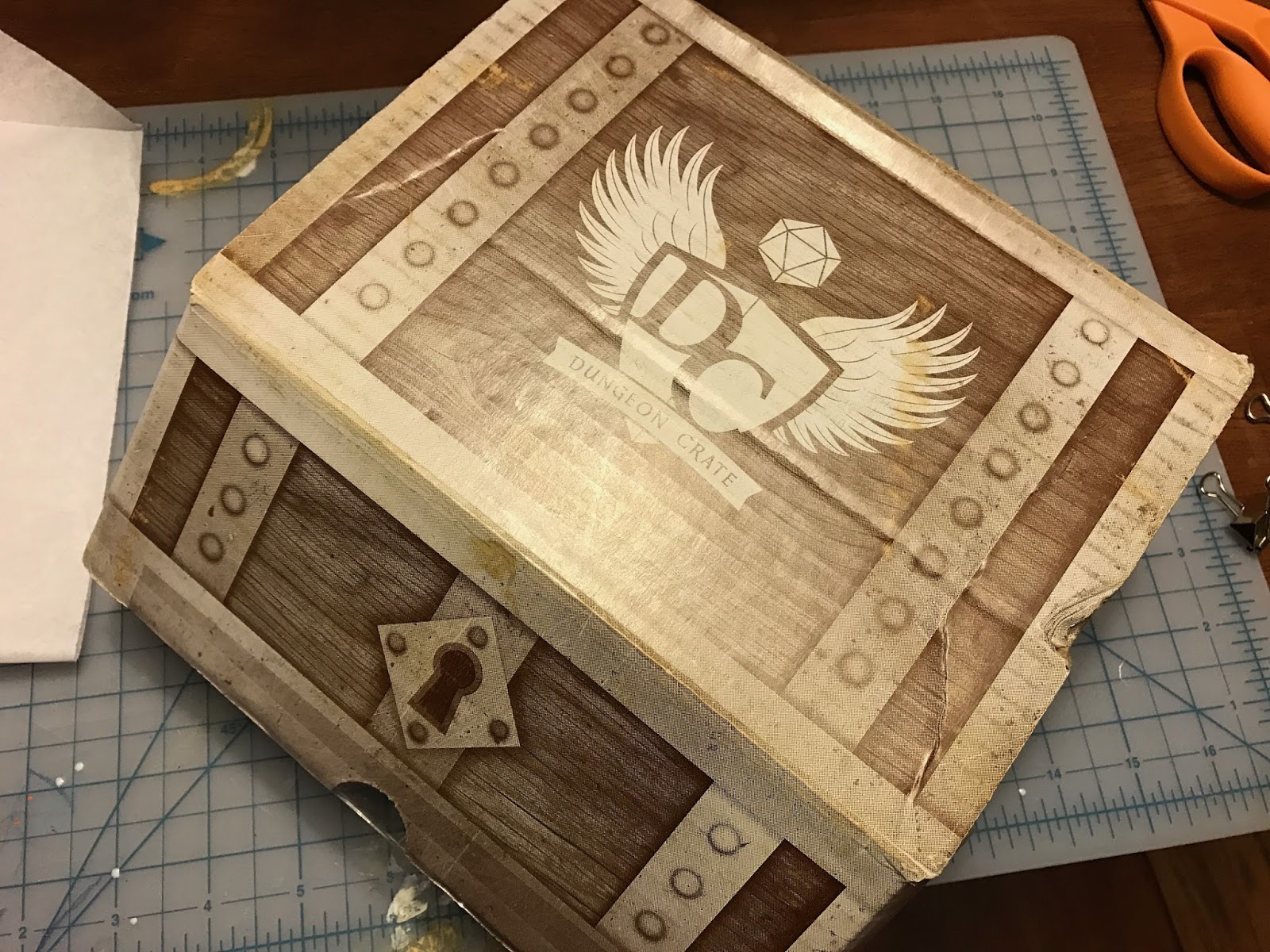
We have a simple solution using something you probably have on your desk right now: a Dungeon Crate box.


We send them to you every month. Now, with this little tutorial and a few other things you likely have sitting around, you can turn that Dungeon Crate box into a mini photo studio. You don’t even need a fancy camera. Your smartphone will do just fine.

Supplies:
1.    Dungeon Crate shipping box
2.    Ruler or tape measure
3.    Pencil
4.    Razor or X-acto knife
5.    Tissue paper
6.    Tape
7.    Poster board or cardstock
8.    Lights

Directions:
1.    Cut off the top of the box.
That flap that says “Dungeon Crate?” Ditch it. We need a box with an open side so we can, you know, place something there and snap some photos.


2.    Measure and cut a 1-inch border.
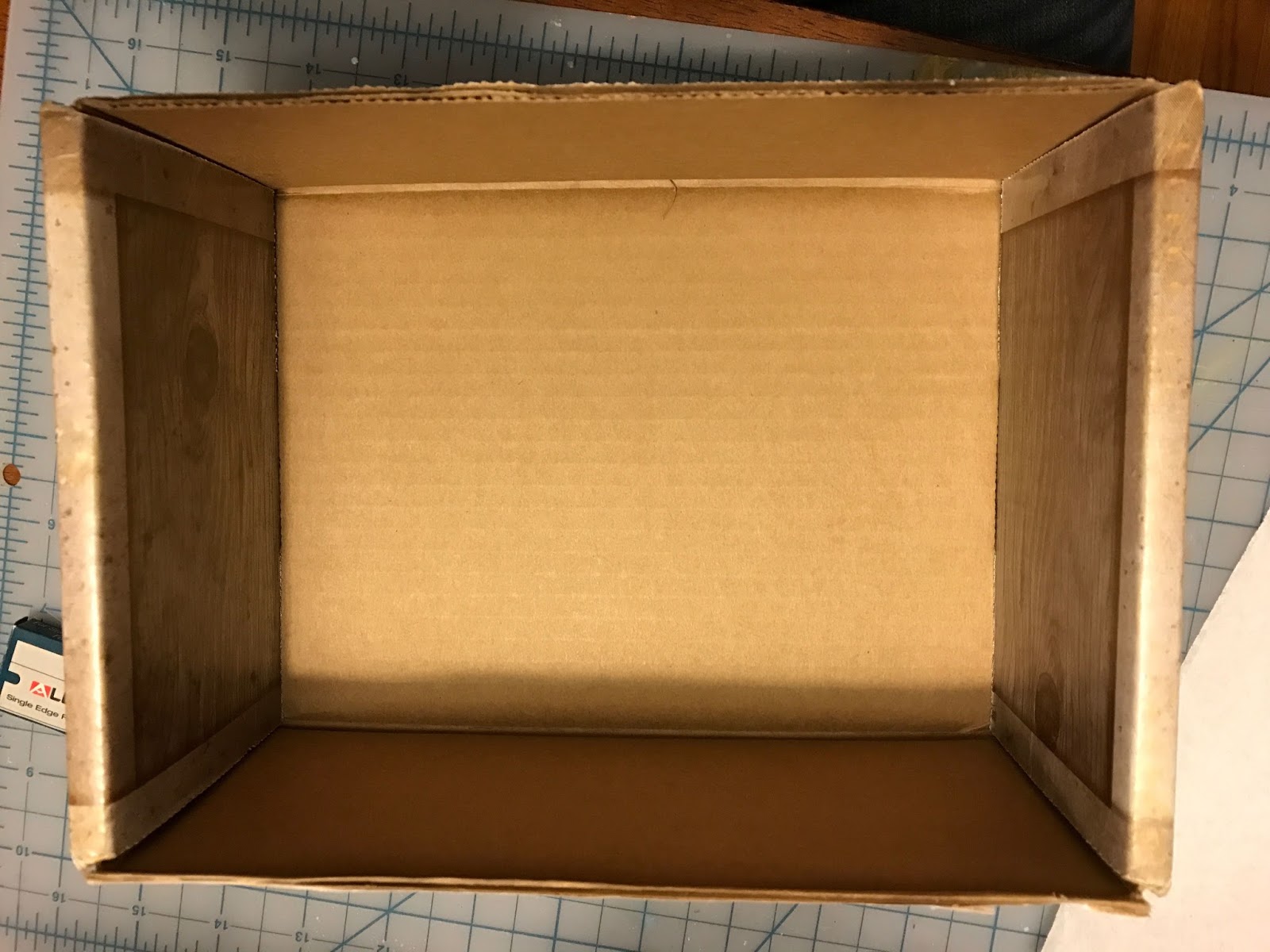
The bottom of the Dungeon Crate box will be the back of your “photo studio.” You’ll need to measure a 1-inch border and cut out the pieces on the right side of the box and then do it again on the other side. Finally, do it on a third side.
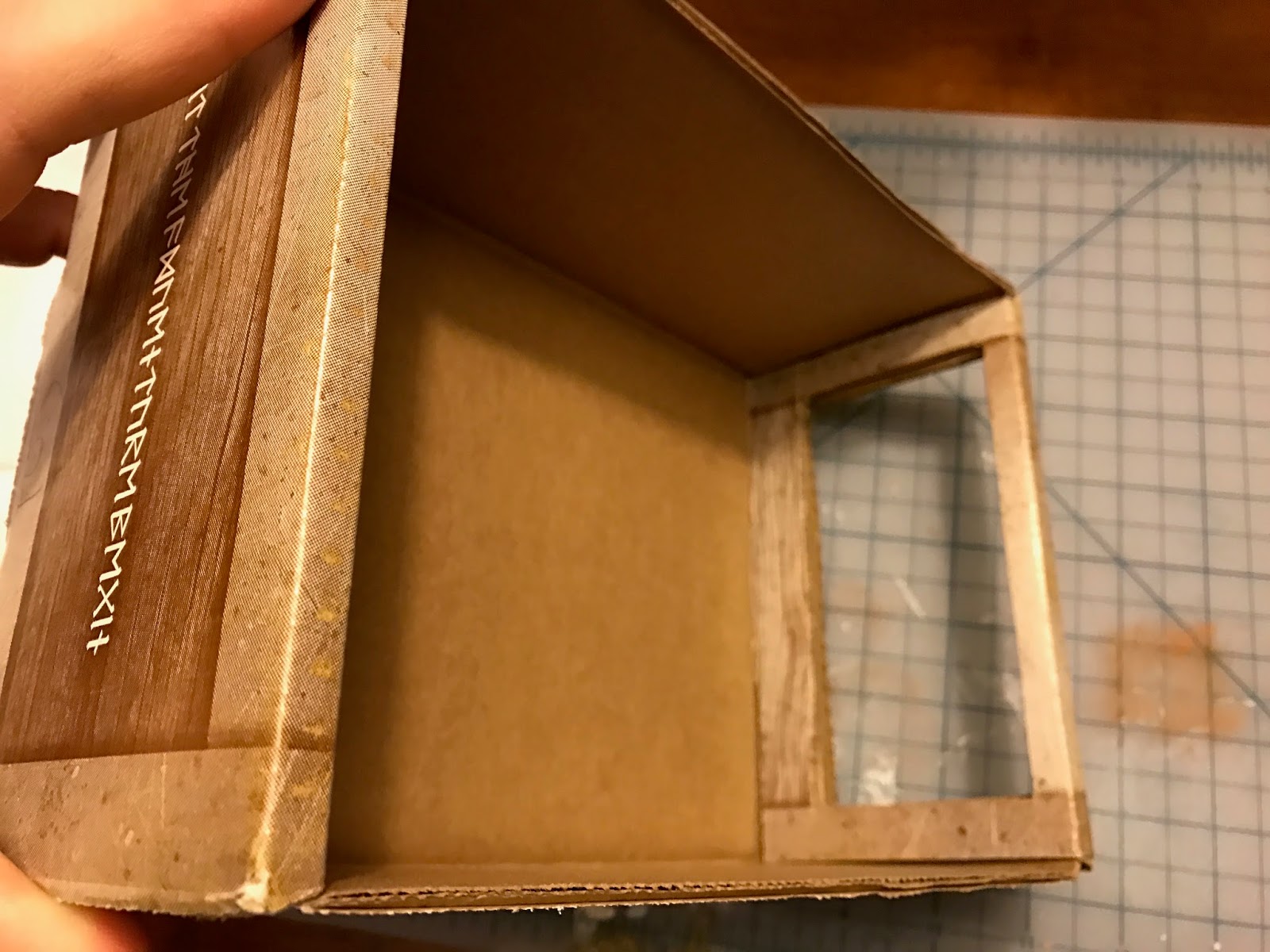
After all that, you should have a box with a back, a base and the other three sides (top, left and right) cut out.


3.    Place tissue paper over each of the cutouts.
This is easy. Hold some tissue paper up to the box’s new cutouts and cut the tissue paper to fit.
Tape the tissue paper over the cutouts. Any sturdy tape should do the job.


4.    Insert your background.
Take the poster board and cut it to fit. It should be slightly larger than the back wall of the box so that when you insert it, it should curve from the inside the top of the box to the front edge on the box’s bottom.
Use paper clips or binder clips to clip it in place.


5.    Place lights outside the tissue paper pieces.
Really, any light will do, but your best bet is bright white lights. Clamp lights work great and if you add light from the top, it will eliminate shadows. Experiment with the lighting and types of bulbs for best results. 

6.    Snap your photos!
Put your miniature or whatever in the studio and take some photos.


7.    Show them off.


Thursday, February 23, 2017

The Best Way to Roll Dice


We all have our dice superstitions.

Ways we jiggle the dice before throwing them. The right height to drop them from. Whether we toss them up in the air or roll them straight down the table.

We probably developed these superstitions over thousands of RPG hours or from that one D&D session where we rolled them just right and landed a massive critical hit.

But what is the best way?

At the craps table in Las Vegas, dice must be rolled from a distance and hit the back wall to be considered a valid roll. The dice are also weighted and measured perfectly so the results come out as randomly as possible.

But are dice rolls truly random? One scientific study showed that dice rolls aren’t as random as you think they are. The best predictor for the outcome of a roll of the dice is the initial position of the die. Rolled with the 1 face up, the most likely outcome is a 1, according to a story from Inside Science.

"[The] top face will always be more probable,” said Thomasz Kapitaniak, a Polish researcher who authored the study.

So, if you’re aiming for a crit in tonight’s Dungeons & Dragons game, keep your die 20-side up and you might just have a better chance of landing that big hit.

And what are the best dice?

We decided to look and find out.

Standard plastic dice sold by Chessex, Q Workshop and tons of others have lots of variations due to the manufacturing process.

Dice are made by casting plastic into a mold. After that, the entire die is painted to make sure the numbers are filled in.

Then the dice are put into a tumbler for polishing, which removes the paint (except in the tiny crevices showing the numbers) and leaves the dice shiny and pretty. The tumbling process also leaves the ever-so-slightly rounded edges you’re familiar with.

Because the dice are physically worn down, that process also leaves dice with small technical imperfections that could influence the outcome of your rolls.

Those “evil” dice that always seem to roll low and the “lucky” set that seem to roll 20s more often? It might not be superstition. They could have worn faces from manufacturing that may cause just enough of a difference to affect your rolls.

Precision dice, on the other hand, are manufactured to keep from having those imperfections and thus roll more randomly. They have sharp edges and typically are sold without paint. (A plus to those of us who remember filling in the numbers with a crayon on old school dice sets.)

The dice have not been painted or put in a tumbler, so they have neat, sharp edges. They are designed to roll more randomly.

But do they?

We decided to test them out.

We took a d20 from a set of regular RPG dice as well as one from a set of precision dice. Then we rolled them through our handy Dungeon Crate dice tower from Advanced Deployment in an attempt to get them to roll as much as possible.

Here are the results:


We rolled each die 100 times. On a d20, there are 20 possible rolls. (Obviously.) If the dice were truly random, each result would come up 5 times.

The results from our (admittedly limited) test were far from completely random, but they didn’t deviate too much.

Almost every result had a deviation less than two, which felt pretty good to us.

Only two results from the standard dice deviated more than that. We only rolled one 6, and we rolled eight 9s.

With the precision dice, there were actually more deviations. We rolled eight 3s, only two 6s and nine 16s.

If you want to get technical, our test showed the precision dice were actually less random.

But just a glance at the graph shows that both dice were pretty random. If you extended this out over 1,000 rolls or 10,000 rolls, these results would become even closer to accurate.

So, we ask again: What’s the best way to roll dice? And what are the best dice to roll?


We say it’s however and whatever you decide to roll.


Get your dice on at Dungeoncrate.com

February Crate Overview


We love dice.

And since you’re a fan of RPGs like Dungeons & Dragons and Pathfinder, we’re sure you do, too.

That’s why we chose “Dice Love” as this month’s crate theme. Everything in this month’s Dungeon Crate is all about helping you roll.

Let’s dive in.

Leather Dice Tray

We dig a good dice tray, especially if you’re on a table or other surface that’s not friendly to rolling dice. But dice trays we’ve had before are a pain to haul around.

Enter this little leather tray from Binding Time. It snaps together to make a bag or dice carrier, then you can pull it apart and snap it back together to make a square tray. Awesome, right? Each one was handmade just for you.

Dice Cup
Sometimes you just need to roll a d20. But sometimes you have a handful of dice (advantage plus damage dice plus bonus dice) and you need something more. Stuff ‘em into this Dungeon Crate dice cup and let them roll!


Plus, isn’t it kind of exciting to rattle those dice around and dramatically dump them onto the table? We think so.

We also love this dice cup from Koplow Games for higher level characters because rolling 12d6 with just your hands isn’t the easiest thing to do.

Green and Gold Dice
This wouldn’t be a dice crate without some actual dice. Each crate comes with a set of green and gold dice from our pals at Chessex.

Dice Dungeon
Bad dice! That thing has been rolling too many critical failures? Lock it up!

Show that die that, unless it starts shaping up, it’s going to stay in there.

Or, you know, protect your favorite die by keeping it in a safe place.

Whether punishing the bad dice or using it as a cool carrier for a favorite miniature, we love this little dice dungeon from Advanced Deployment.
  

Potion and Heart Tokens
Sure, you can keep track of things on your character sheet, but where’s the fun in that?

With these acrylic tokens from Advanced Deployment, you can physically assign potions to players or keep track of health.

Adventure
Welcome to the Carrionholme.

This hideout is home to a coven of three hags who have bound slimes, oozes and puddings to their service inside their partially submerged dungeon.

Designed for Dungeons & Dragons 5th edition and 4 level-8 characters, Carrionholme is a creepy, gross place where adventurers will have to keep their wits about them.

Adventure-a-week provides yet another excellent one-off dungeon crawl, this time complete with gross trophies, creepy enemies and deadly traps.


Wednesday, February 1, 2017

Using Fantasy Themed Metal Coins in Your RPG

One of the inspirations for starting Dungeon Crate was a trip to GenCon in 2015. I loved the vendor floor and was fascinated by the fantasy coins I found on the tables of Shire Post Mint and Rare ElementsFoundry. I am proud to now have both companies providing fantasy coins to subscribers of Dungeon Crate.

How Do You Use Coins in Your RPG Games?
There are many ways to use real coinage at your gaming sessions. If you’re a fan of RPG accessories, you may already use tokens or other forms of tabletop notation. Bringing in beautifully struck, genuine metal coins offers a real-world element that enhances the gaming experience.

Below is a list of how you can incorporate metal fantasy coins into your game.

1.    Use as Inspiration tokens
2.    Flip a coin to make a heads or tails decision
3.    Offer a coin as a reward for outstanding play at the end of the session
4.    Gift coins to players and Dungeon Masters
5.    Use coins to mark treasure locations on a game table map
6.    Incorporate them into an adventure as a signet for safe passage
7.    Use coins as currency in tavern games of chance
8.    Have players use real coins to represent personal treasure

Using Coins as a Representation of Character Treasure
Something that I’m experimenting with in my own D&D group is using coinage to represent a character’s personal treasure. Maybe not their entire wealth, but what they carry on them. It makes for fun gaming as the players collect and exchange coins for everything from common items to magic weapons. They can exchange coins for jewels to gain more room in their coin purses. They can also wager them at the local tavern’s game table or even lose them to the occasional pick pocket or thief.

The Dungeon Master/Game Master acts as a sort of banker, coming up with an exchange rate, coin denominations, regions on where each coin is from, and other details. This does take a bit of work if you discard the standard PP, GP, SP, EP, and CP mechanic, and use a more universal mechanic. This can be as simple as using the word “gold” to represent something like how the English use the word “pound” for their dollar. Break it down from gold to half gold, quarter gold, etc., using existing denominations on the coins and coming up with your own with coins that don’t.

Coins Become Part of the Adventure
Doling out found treasure and splitting up party treasure becomes even more fun when comparing a variety of metal coins. I find this tends to make treasure more valuable to players. And of course, collecting and spending coins is simply fun.

Incorporating coins can be a pricey venture, but there are several coin manufacturers that make a wide variety of metal coins for game-play in volume, at affordable prices. Some manufacturers create thematic coins such as Dwarf, Elf, Spartan, and Pirate themed coins. Others like Rare Elements Foundry offer highly detailed artistic coins that have versatile fantasy themes. Shire Post Mint offers licensed coinage where you can buy coins from Conan the Barbarian, Lord of the Rings, and Game of Thrones.

Whether you’re a collector or just want to add spice to your game, I hope you have as much fun as I do using real coins. If you subscribe to Dungeon Crate, then you’ll enjoy metal coins throughout the year. I encourage you to patronize our coin vendors and check out what else they offer.


Adventurers be warned! Collecting fantasy coins is addicting.