Friday, September 22, 2017

Our favorite Wizard spells in 5th Edition


A wizard is only as good as his spellbook.

Other classes get their spells granted by their deities or can innately cast a few spells. But wizards get to assemble a verita

But if you’re playing a wizard, you get the benefit of a spellbook where you can record any number of spells from the seemingly massive wizard spell list.

If you’re like us here at Dungeon Crate, some of the most fun you’ll have when creating a new character is assembling your spellbook and choosing what spells to prepare.

Put a different way: Determining how we’re going to destroy the day’s enemies with fire, thunder and meteors crashing down from the sky makes us giddy with excitement.

Thankfully, Dungeons & Dragons 5th edition has some pretty awesome spells. We combed through the extensive spell list from D&D 5e to pick our absolute favorites - the most useful, the most fun and, yes, the most destructive.
  
Animate Dead (3rd level) - Have a big encounter coming? Cast this as many times as you’re able and command an army of skeletons (or zombies, your choice) in your next battle.

Catapult (1st level) - Fling stuff at your enemies. Hard.

Chill Touch (cantrip) - It’s a cantrip that does minor damage, but it has one major effect: Keep the target from regaining hit points until your next turn. Use it against big, bad, regenerating enemies.

Clone (8th level) - Want to safeguard against your death? This is your jam. Create a clone of yourself so that, if you die, your soul transfers to the clone. Then you’re safe.

Cloudkill (5th level) - Drop a nasty fog in a space, and watch everyone choke to death. Plus it moves. You could drop it right in front of you and let it roll across the battlefield.

Counterspell (3rd level) - As a reaction, automatically counter a spell. This can give huge advantages to any wizard who has it prepared.

Delayed Blast Fireball (7th level)  - Instead of a giant fireball, this creates a little beat of light. But when the spell ends, either because you decide to or someone walks into it, it erupts into a massive ball of fire. In short: You get to drop a tiny trap in the middle of the battle and trigger it whenever you feel like.


Drawmij’s Instant Summons (6th level) - Summon literally any item from wherever it is to your hand in an instant. There are limitations, including using an expensive sapphire each time, but being able to bring magic items straight to you at any time (from any place) could be incredibly useful.

Evard’s Black tentacles (4th level) - Squirming tentacles fly out of the ground, grabbing everything and squeezing them. Hard. Great to keep someone wher eyou want them plus do some serious damage.

Haste (3rd level) - Turn a fighter or rogue (or really anyone in your party) into an absolute beast with doubled speed, +2 to AC, advantage on Dex saving throws and a bonus action each turn. Woof.

Incendiary Cloud (8th level) - Appears to be smoke. Actually a hot, fiery, death-dealing cloud.

Locate Creature (4th level) - Simple but effective: Find what you’re looking for. This is the best when you’re seeking a specific enemy or creature.

Magic Missile (1st level) - Guaranteed damage is huge, plus it’s very effective against opposing spellcasters since three automatic hits means three concentration checks if they’re holding onto a spell.


Melf’s Minute Meteors (3rd level) - Six tiny meteors float around you until you decide to fire the explosive little rocks at anything you feel like. A simple spell that can do some serious damage.

Minor Illusion (cantrip) - Yet another cantrip with a minor effect - create a sound or image of an object - but it has no verbal component. You can hide, remain hidden and use this to distract guard and other creatures.

Misty Step (2nd level) - Only a second level spell, you can get this simple but effective teleportation spell early in your character’s progression.

Modify Memory (5th level) - There’s a million ways to use this effectively. It can create serious advantages in roleplay scenarios, bending someone to your will by changing, modifying or deleting memories.

Mordenkainen’s Magnificent Mansion (7th level) - Summon a freaking mansion. Seriously. This spell comes with a giant dwelling, 100 servants and 24 hours of safety. You can slip away to safety, use it to camp in a cold forest or simply to relax whenever you feel like it.

Otto’s Irresistible Dance (6th level) - This one’s all in the flavor text. It effectively causes the target to lose their movement and be subject to advantage on all attacks against them. Why? Because they can’t stop dancing. Hilarious.

Phantasmal Killer (4th level) - Literal nightmare fuel, this spell pulls something from a creature’s deepest, darkest fears.

Power Word Kill (9th level) - Insta-kill. You say a few words. The target dies. Bam.

Simulacrum (7th level) - Summon one beast or humanoid that obeys your commands. Sure, there are some limitations (½ hit points, it costs some gold, etc.), but you get a powerful minion to do your bidding.

Sleep (1st level) - It’s a simple one, but boy is it effective especially when facing an army of lower-level enemies.

Thunderwave (1st level) - Push people around the battlefield. Especially effective if you’re playing on top of a precipice, tower or cliff.


Monday, September 11, 2017

Game Table Etiquette


It’s time to play.

Play means fun, and we can’t have fun if people are being jerks, being disrespectful or looking at Facebook instead of paying attention to the game.

Be respectful. This is the big one. If you’re disrespectful to the GM and other players, go ahead and show yourself the door. This is people’s time to have fun, to let loose, to try new things. If you’re a jerk, you’re not welcome at the table.


Try something new. Always playing that elven ranger with a pair of magic swords? Mix it up for once. Try a different class. Maybe a way different class. Go crazy and get out of your comfort zone.

Be present. Pay attention. Put your phone down. Engage in the game. It will be better for you and better for the game.

Be on time. This goes both ways: Starting and ending the game. No one wants to plan for a three-hour session that’s supposed to start at 7:30 p.m. but getting to play for only an hour because no one showed up until 9 and most of the players have to leave by 10.

Don’t be messy. First off, you’re at someone’s house, so pick up the crumbs and clean up after yourself. Also, there’s usually limited space at the game table so try to contain your rulebooks, character sheets, soda cans and dice to your area.

Don’t argue with the GM. Your friend worked hard to prepare for the game. You’re certainly allowed to object to her rulings, but do so briefly at the game table. If you still think she got it wrong, approach her afterward and present your case.
Be there. Life happens, but if you're not going to make the game, tell the GM at least a day before so he can plan ahead. There's nothing like hours of preparation for a five-person party only to have two people bail at the last minute and you have to adjust every encounter on the fly.
Be cooperative. If you want to battle monsters on your own, go play a video game. This is about playing together.

Respect the house rules. These are both rules about the house (only use the bathroom in the basement) and rules the GM made up for the game (+1 to anyone who announces their action at the beginning of their turn).

Put down that phone. Unless that’s where your character sheet is, leave it in your bag. You can look at memes later.

Share your snacks. This one is like kindergarten: Don’t bring food unless you brought enough for everyone. It’s a nice thing to do.

Bring all your stuff. Before you leave for the game, check to make sure you have your dice, character sheet, books, pencils, miniature and anything else you might need.


Don’t touch my dice without asking. You brought dice (or at least you should have), so don’t take mine unless you ask first. 
Want cool stuff to warm up your players or Dungeon Master? That's where Dungeon Crate comes in. Check out our site for treasures that will enhance your game on and off. 

Friday, September 8, 2017

Interview with Floyd Cocklin - Author of Whiskers in the Dark


Dungeon Crate made an epic team-up this month.

The boys at Nerdarchy curated August’s crate, and it is fantastic. The crate contains all kinds of nods to Dave, Tom and Nate. But the biggest is “Whiskers in the Dark,” an adventure in which you save a trio of strangely familiar dwarves from a dark and mysterious fate.

The dwarves are, of course, modeled after our friends at Nerdarchy. Our own Floyd Cocklin whipped up the devious adventure, and we talked to him about how he came up with the story, how Nerdarchy had its stamp on the adventure and how he designed a rather cunning trap.

Dungeon Crate: The adventure revolves around saving some dwarves, which are modeled after the fellas from Nerdarchy. How did you work Nerdarchy into the adventure?

Floyd Cocklin: When I was trying to come up with ideas for the adventure, there were three dwarves and a couple of other creatures to work with. I certainly didn't want to make the dwarves the antagonists in the adventure but also didn't want them to be completely on the sidelines. I figured a rescue adventure would give the players a chance to free some helpers for the last encounter and help turn the tide of that battle.

DC: The gelatinous cube trap is completely devious. How did you come up with that one?

FC: This is a favorite I've used a couple times over the many, many years I've played D&D, and it never ceases to surprise the players. I had one player who always played thieves and was always sort of cocky about it. They would do these dungeon crawls and always find the traps and bypass them, often by rolling to detect traps across every stretch of corridor in the whole complex.

I figured a little misdirection was warranted, so I put an easy-to-find pit trap in the last corridor before the treasure vault of a dungeon I designed. They were on the last of about six sessions in this dungeon and had figured out all the puzzles and traps up to that point. The rogue found the pit trap and didn't think to do a spot check *beyond* that trap. He did an acrobatic elven leap over it and slammed face-first into the cube, tumbling unceremoniously into the pit. He only took the 1d6 falling damage and thought he had run into a Wall of Force or something like that. Then they all heard the scraping sound . . . .

They managed to get him out from under the cube but it added a fun bit of tension to the end of a very long adventure where they could finally see the finish line.
 
DC: I also like the "coin of fate" mechanic. How did you come up with that one?

FC: I've always enjoyed the idea of magic items that didn't necessarily always have a boon to bestow — the quintessential D&D example being the Deck of Many Things. I wanted to put something luck-related into the adventure that may or may not help a character in a tight situation. They rolled a 14 on their attack or saving throw and so they're thinking "is that high enough?" So, they have to make a decision on the margin about it. Unlike using Inspiration, where they always take the higher of two rolls, this seemed like it would be appealing to players who like a little bit of risk but wasn't game-breaking.

DC: This is more a thinking adventure than a fighting adventure (for the most part). Do you like those kinds of adventures?

FC: Several years ago, with the coming of virtual tabletops, I got to play with my old high school friends again. I put together a massive dungeon crawl as a sort of "reunion tour" from not having played together for 15 years. And the players fell right into their old roles and habits from back in the day, which meant they could mow through traditional encounters like a well-oiled machine.

Back in the day we only did "theater of the mind" using 2nd Edition rules but the games were always heavy on action. With the tactical aspects available in 5th Edition and the ease of designing battlemaps on a virtual tabletop, I started thinking about encounter design in a more tactical sense. I think this adventure has plenty of fighting but it's not designed to be something the player-characters just mow through. All the best stories we have are about encounters with elements other than just smacking the BBEG until they drop. This adventure has a time sensitivity to discourage exploiting rests and puts pressure on the player's resources, like with the rust monsters milling about right from the start. Since most of the encounters feature a singular foe against the whole party, I wanted to put in elements that forced the characters to use actions for things other than just swinging the sword or lobbing the magic missile. This adventure is very much in the spirit of how I run my games.

DC: I like the open-ended nature of the adventure. Any plans to expand upon it?

FC: When I came up with the concept, I wanted it to be something in the spirit of the “Side Treks” adventures from the old Dungeon Magazines I had in high school. The players are between adventures and something pops up right in front of them. In this sense, the DM can drop it in as-written and have a nice side quest that they can run as a break from the regular campaign.

At the same time, I also wanted to leave it open-ended. I wanted to be able to integrate this adventure with some of the bigger adventures we have in the Dungeon Crate pipeline so that it fits seamlessly into the setting. For the October crate, I have some plans on how to expand it past the Mindbender's lair and delve into the yawning depths below.

DC: What else is down in those depths?

FC: The Kron Mountains have had a lot of uncharacteristic seismic activity lately. To the dwarves of Banduhr, this means the possibility of finding some adamant deposits. But there are things down there that have their own designs that will put a real kink in their plans.

DC: Vhulk'hys and his companions seem like nasty dudes. What are their aims?


FC: I've always been a fan of aberrations, Lovecraftian-style horror and grimdark games, so these guys are obviously lifted from that. Their minds and their motives are alien to the rest of the mortals and they are being driven closer and closer to civilization by whatever else is deep in the heart of the mountains. A city of dwarves seems like an abundant food supply for both themselves and whatever else hungers below. But their goals are beyond just mere sustenance, grander designs also await. Stay tuned! 

Tuesday, August 29, 2017

August Nerdarchy Celebrity Partner Crate


This crate is stacked.

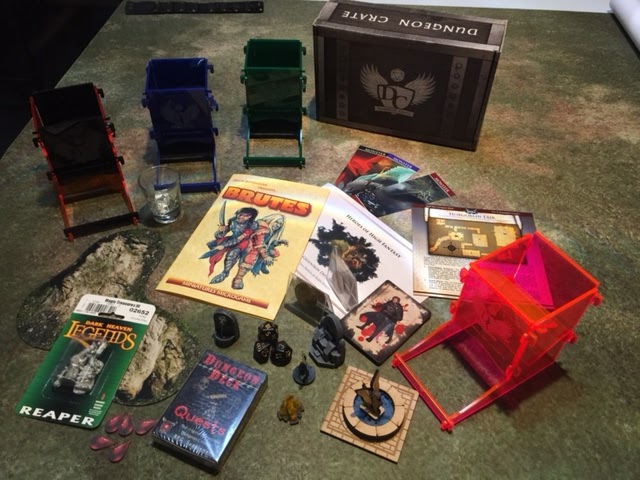
Dungeon Crate teamed up with Nerdarchy to curate this month’s crate, and there’s some awesome exclusive Nerdarchy branded and themed items you can use in your D&D and Pathfinder games.

Even if you’ve never heard of Nerdarchy til now, there’s a lot of great stuff to use on your game table in your next session. Everything in this box is something you can use in your RPG sessions.

Do you like dwarves? You’re gonna love this box.

Of course, this box once again contains a mini adventure module, and all the pieces in the box are useable in that module.

So, let’s get to it!

Whiskers in the Dark
Written by Dungeon Crate’s Floyd Cocklin, this four-page adventure involves the fellas from Nerdarchy. A trio of dwarves have been captured, and they need your help. The adventure has some baaaaad monsters and an incredibly ingenious trap that’ll take some clever roleplaying to pass. This month’s Digital Dungeon Crate has a bunch of extras for the adventure, including monster stats and extra artwork from Dungeon Doodles. It’s awesome.


 ArcKnight Minis
Included in this month’s box are six flat plastic miniatures - three dwarves, a gelatinous cube, a mind flayer and a roper. You know those cardboard pawns? This is what happens when they level up! ArcKnight prints them on clear plastic sheets, and the miniatures show a front and a back to each character and monster. They look slick on the game table. These are all usable in any game and they’re also part of Whiskers in the Dark.


Beardspiration tokens
Once again, these tie into the included adventure and are a nice little nod to the bearded gentlemen at Nerdarchy. These acrylic tokens lovingly crafted by Advanced Deployment are intended to use with the Inspiration mechanic in D&D 5th edition. Best used with dwarven PCs or your more hirsute friends.


Nerdarchy Dice Bag
Your dice bag is overflowing. Ours, too. Now you have some extra space with this neat little cloth bag sporting the Nerdarchy logo.


Mini Dice Tower
Dungeon Crate has delivered full-size dice towers in the past, but we dig this miniature design. Cut and assembled by Deep Dungeon Games, this small wooden dice tower is extremely portable and looks cool. It sports the Nerdarchy logo and it’s a great little item to make your dice rolls more random.


Rune Dice
Tired of stepping on sharp d4s? Or flipping a coin? These sweet little items from Q Workshop are about the size of a d6, but their rounded edges give them only four sides. They roll well, and they look cool, too. Plus, they’re edged in runes, making them great for your dwarf PC. We love unique dice.


Nerdarchy Button
Show your love for Nerdarchy! It’s a cool little button. Does your button have a goblin on it? You win a prize! Drop an e-mail to wayne@dungeoncrate.com.

Axe of Durin coin
More dwarf stuff! These coins are pretty sweet. Minted by Shire Post Mint, these “Lord of the Rings” coins depict the famed dwarf Durin, father of dwarves, on one side and his axe on the other. It also has a description in Angerthas runes about Durin


Treasure Deck
This is a replacement item from last month’s crate PLUS it’s an awesome item unto itself. Unfortunately, Nord Games had an issue with their printer and July’s crate included those decks. But the folks at Nord are super cool, and they replaced those decks with the proper ones in this month’s crate. So, if you subscribed last month, you’ll end up with two of these. (Share with a friend!) If you just joined up this month, bonus item!

Anyway, the decks were created for D&D 5th edition, and they let you randomize treasure in a dungeon by drawing a card. The deck has more than 200 items, keeping things interesting. Each deck has 52 cards, and each card has four treasure options. Each card has complimentary items, so you could use each one together. The deck is also used in the adventure, but you can use it for any game you’re playing.

A donation to charity

Feel good about getting Dungeon Crate this month. Or at least, feel even better than your normally do when opening your box of loot. A portion of every box went to charity. Nerdarchy chose Reading is Fundamental, which is committed to literacy. 


Monday, August 7, 2017

Our Favorite Rogue Archetypes in D&D and Pathfinder

If you’ve played a rogue in any party, you’ve likely been a thief of some kind.


The thief’s ability to snatch items from unsuspecting folk - say, a powerful magic item from under the nose of a dastardly bad guy - as well as their penchant for disabling traps, picking locks and having a nose for gold make the thief a pretty likely choice when building a character.

Who doesn’t like being the Han Solo type as they steal, smuggle and smarm their way across a campaign?

But as much as we love thieves, we dig the other wild abilities rogues can get into. We dug through the annals of Dungeons & Dragons to find our favorite rogue archetypes, subclasses and variants.

Spellthief - This 3.5 class functioned like the rogue, except it substituted the ability to steal magical abilities and even spells in place of the sneak attack. As described in the book Complete Adventurer, the spellthief can roll up to a powerful sorcerer, attack and (instead of dealing sneak attack damage) steal one of the sorcerer’s spells and cast it himself. Pretty badass, huh?

Relic Raider - Do you want to play Indiana Jones? This Pathfinder rogue archetype from the Black Markets sourcebook is what you want. The Eric raider specializes in stealing artifacts and items from dungeons and castles. We like the disable curse power (disable curses like you would a trap), which comes in handy when you're raiding a cursed tomb looking for gold and glory.

Lurk - Rogues use cunning and guile to pick pockets, hide in plain sight and deal backstabbing damage, but the lurk uses psionic powers to find weaknesses in enemies and exploit them. They operate like rogues and deal sneak attack damage but use special psionic abilities to augment their attacks. Lurks were published in the 3.5 edition book Complete Psionics.


Shadow Walker - From 2nd edition’s Wizards and Rogues of the Realms comes this take on a rogue, which uses limited magic ability to keep yourself hidden and use various shadowy powers. It’s a creepy one, but very effective.

Assassin - Better than having a few skills and lockpicks is the ability to shift through shadows, use poisons and quite literally stab people in the back. If you dig the rogue’s ability to move about unseen or take down big bad guys, this is that in steroids.

Swashbuckler - Another 3.5 class, this one from the Complete Warrior sourcebook, it's a combo between rogue and fighter classes. They deal damage like fighters but move with finesse like rogues. Tasty.


Mastermind - Want to work the king’s court and use your words as much as your weapons? This 5th edition archetype will let you master misdirection, tactics and manipulation in addition to straight attacks.

Arcane Trickster - One of the least used rogue options, the arcane trickster is awesome for one reason: Mage Hand. Want to pick a lock you suspect of being trapped? Do it from 30 feet away using Mage Hand. Want to take the wand from the evil wizard and render him useless? Mage Hand. There are lots of other ways to employ this rogue archetype’s little bag of magical wonders.

Heister - Looking to steal? This Pathfinder rogue archetype is a stealthy, unseen thief that's good at picking locks and taking what isn't his. He's your man if you're planning any kind of heist. 


Wednesday, August 2, 2017

Dungeon Crate in the Making

Filling a box of loot seems easy: Pick some cool items, drop them in the box and send them off.

But it’s not.

Don’t get us wrong, working on Dungeon Crate is the coolest job in the world. It’s also lot of work.

Let’s give you a little behind the scenes look into how we put together your boxes of gaming loot every month. The Dungeon Crate you opened this month started several months ago.

We’re D&D and Pathfinder and RPG players with decades of gaming experience, and we know what we like to use when we play. If you’re anything like us, you’re going to love it, too.

The first thing we do is find a theme. Recent themes included Dungeon Lifestyle and Thieves. Once we have a theme, we start dreaming up ideas about what items could go into the crate including adventures, tokens, miniatures, terrain, cards and tons more. (If you subscribe, you know exactly what we’re talking about.)

And this is where we get a little pie-in-the-sky.

We come up with wild ideas about customizing items or dreaming up items that don’t exist. But here’s the cool part: A lot of times, those dreams actually come true.

Let’s look at the thief crate.

That started with our adventure, Against the Dead Hands, and ended with some awesome custom items.

We were finishing up the adventure’s final details while we were putting the box together, but we had an outline that got us thinking.

What monsters and NPCs were in the module? What was the story? What other pieces could we fit into the box that would complement the adventure?

One of the pieces we thought of early was the Dead Hands coin. The thieves’ guild that takes a starring role in Against the Dead Hands was first mentioned in the previous adventure, Xander’s Lost Orb, so we already knew a bit about them.

Could we make a custom coin for the adventure?

We started talking to our friends at Advanced Deployment and found out, yes, they could totally make us an acrylic token exactly like what we wanted. Awesome.

Meanwhile, our list of items for the box was getting bigger and bigger. We figured out what would work and what wouldn’t and started contacting our pals at Reaper Miniatures, Nord Games and elsewhere to get the items for the crate.

We also wrapped up editing the adventure and sent everything to our shipping facility.

We’re proud of that last crate, and it’s one of the most packed we’ve done.

Our next crate, done in partnership with the fine fellas at Nerdarchy, is shaping up similarly.

We’ve dreamed up a host of items, several of them custom pieces, and we’re trading ideas back and forth with the guys at Nerdarchy to make this a truly awesome crate.

We’ve been working on it for awhile and are just know locking down the details. And yes, we’re already getting items for crate after that as well as plotting out the next several crates.

If you want to know what to expect in your crates, there’s lots of information available. We review the crates every month right here on this blog, but there’s also tons of unboxing videos and reviews out there, too.

If you do a little homework, you’ll know exactly what to expect even if each month’s contents are a surprise. (That’s kind of the fun of it, you know?)

We pack tons of value into each crate. The actual retail cost of each crate is typically double what you pay, so you’re getting a deal.

If you’re already subscribed, we can answer your questions. We’re as communicative as we can be on social media, our e-mail newsletters and especially if you contact us in person. By the way, if you reach out, you’re talking to an owner, not some faceless minion. That’s how much we care about our customers.


Tuesday, August 1, 2017

Q&A with "Against the Dead Hands" Adventure Designer Kevin Coffey


We’re building the world of Halcyon.

This month, Dungeon Crate released the second in a series of adventures that take place in our very own campaign setting.

The world of Halcyon has everything - fiery dragons, forsaken gods, fiendish orcs, wild magic and lots more.

For starters, we’re diving into the area of Rhimms. Our first adventure, Xander’s Lost Orb, and our brand new adventure, Against the Dead Hands, take place in the region and mark our first expedition into Halcyon.

We talked to adventure designer Kevin Coffey, who wrote both adventures, about the direction of Against the Dead Hands and how it incorporates loads of items from Dungeon Crate.

Q. Is this adventure related to the last one?

A. It’s a direct continuation of Xander’s Lost Orb. DMs could run them back to back as part of a campaign. And a third adventure, which you’ll see in a future Dungeon Crate, comes right after this one.


They all take place in Dungeon Crate’s world of Halcyon. It’s been fun fleshing out the continent and its locales.

Q. Where does this adventure pick up?

A. It continues from where Xander’s Lost Orb left off. In that adventure, a young lord asks the adventurers to help him find an artifact, a magical glowing orb, that was once in the possession of his grandfather. He wants it to help fight off an army of orcs.

In Against the Dead Hands, the lord still needs some help. He’s busy prepping for a fight with the orcs, so he needs some help at home. There’s a thieves’ guild called the Dead Hands that is causing him trouble, so he asks the adventurers to help.

Q. What was the idea behind it?

A. I love the idea of a thieves’ guild with these bad guys having a private bar where they conspire, keep treasure and all that stuff. And what would it be like to raid the place where all these thieves are hanging out?

It’s always sounded like a ton of fun to me, and writing a den with all this treasure and drunk thieves and stuff was a blast.

Q. So it’s just a straight raid?

A. Not exactly. Even though it’s designed to be a single-session adventure, I tried to make it as robust as possible. The adventure presents several different ways to tackle it, depending on how the players want to do it. I don’t want to give too much away (check out the adventure!) but they could knock down the door or infiltrate the place as thieves or sneak in any number of ways. It should be fun.

Q. Where does it lead?

A. Well, it’s set up to take you one way, but it goes a slightly different direction by the end that sets up the third adventure, which I’m working on right now.

Q. This month’s entire Dungeon Crate box is centered around thieves. Are any of the pieces from the box usable in the adventure?

A. Actually, a ton of them are used in the module. As always, we wanted the adventure to be playable with little preparation, so we worked really hard to match up items from the box to the adventure. Some items were specifically picked to use in Against the Dead Hands.

My favorite piece is the Dead Hands coin made by Advanced Deployment. The thieves each carry a special coin that’s sort of an identifying badge, and if you have one, it makes getting in and out of the thieves’ guild quite a bit easier. The coin in the box bears the Dead Hands’ mark, and it’s beautiful whether you’re using it with the adventure or as an inspiration token or whatever. Advanced Deployment did an excellent job.


People should also be sure to check out the digital crate, which has a bunch of pieces related to the adventure including artwork and maps.


Kevin is a Dungeon Crate contributor and  and a writer for the Omaha World Herald. He rolls dice, writes adventures, and goes to a lot of concerts. His blog Crit for Brains offers more words and stuff to point your eyeholes to.