Thursday, February 23, 2017

The Best Way to Roll Dice


We all have our dice superstitions.

Ways we jiggle the dice before throwing them. The right height to drop them from. Whether we toss them up in the air or roll them straight down the table.

We probably developed these superstitions over thousands of RPG hours or from that one D&D session where we rolled them just right and landed a massive critical hit.

But what is the best way?

At the craps table in Las Vegas, dice must be rolled from a distance and hit the back wall to be considered a valid roll. The dice are also weighted and measured perfectly so the results come out as randomly as possible.

But are dice rolls truly random? One scientific study showed that dice rolls aren’t as random as you think they are. The best predictor for the outcome of a roll of the dice is the initial position of the die. Rolled with the 1 face up, the most likely outcome is a 1, according to a story from Inside Science.

"[The] top face will always be more probable,” said Thomasz Kapitaniak, a Polish researcher who authored the study.

So, if you’re aiming for a crit in tonight’s Dungeons & Dragons game, keep your die 20-side up and you might just have a better chance of landing that big hit.

And what are the best dice?

We decided to look and find out.

Standard plastic dice sold by Chessex, Q Workshop and tons of others have lots of variations due to the manufacturing process.

Dice are made by casting plastic into a mold. After that, the entire die is painted to make sure the numbers are filled in.

Then the dice are put into a tumbler for polishing, which removes the paint (except in the tiny crevices showing the numbers) and leaves the dice shiny and pretty. The tumbling process also leaves the ever-so-slightly rounded edges you’re familiar with.

Because the dice are physically worn down, that process also leaves dice with small technical imperfections that could influence the outcome of your rolls.

Those “evil” dice that always seem to roll low and the “lucky” set that seem to roll 20s more often? It might not be superstition. They could have worn faces from manufacturing that may cause just enough of a difference to affect your rolls.

Precision dice, on the other hand, are manufactured to keep from having those imperfections and thus roll more randomly. They have sharp edges and typically are sold without paint. (A plus to those of us who remember filling in the numbers with a crayon on old school dice sets.)

The dice have not been painted or put in a tumbler, so they have neat, sharp edges. They are designed to roll more randomly.

But do they?

We decided to test them out.

We took a d20 from a set of regular RPG dice as well as one from a set of precision dice. Then we rolled them through our handy Dungeon Crate dice tower from Advanced Deployment in an attempt to get them to roll as much as possible.

Here are the results:


We rolled each die 100 times. On a d20, there are 20 possible rolls. (Obviously.) If the dice were truly random, each result would come up 5 times.

The results from our (admittedly limited) test were far from completely random, but they didn’t deviate too much.

Almost every result had a deviation less than two, which felt pretty good to us.

Only two results from the standard dice deviated more than that. We only rolled one 6, and we rolled eight 9s.

With the precision dice, there were actually more deviations. We rolled eight 3s, only two 6s and nine 16s.

If you want to get technical, our test showed the precision dice were actually less random.

But just a glance at the graph shows that both dice were pretty random. If you extended this out over 1,000 rolls or 10,000 rolls, these results would become even closer to accurate.

So, we ask again: What’s the best way to roll dice? And what are the best dice to roll?


We say it’s however and whatever you decide to roll.


Get your dice on at Dungeoncrate.com

February Crate Overview


We love dice.

And since you’re a fan of RPGs like Dungeons & Dragons and Pathfinder, we’re sure you do, too.

That’s why we chose “Dice Love” as this month’s crate theme. Everything in this month’s Dungeon Crate is all about helping you roll.

Let’s dive in.

Leather Dice Tray

We dig a good dice tray, especially if you’re on a table or other surface that’s not friendly to rolling dice. But dice trays we’ve had before are a pain to haul around.

Enter this little leather tray from Binding Time. It snaps together to make a bag or dice carrier, then you can pull it apart and snap it back together to make a square tray. Awesome, right? Each one was handmade just for you.

Dice Cup
Sometimes you just need to roll a d20. But sometimes you have a handful of dice (advantage plus damage dice plus bonus dice) and you need something more. Stuff ‘em into this Dungeon Crate dice cup and let them roll!


Plus, isn’t it kind of exciting to rattle those dice around and dramatically dump them onto the table? We think so.

We also love this dice cup from Koplow Games for higher level characters because rolling 12d6 with just your hands isn’t the easiest thing to do.

Green and Gold Dice
This wouldn’t be a dice crate without some actual dice. Each crate comes with a set of green and gold dice from our pals at Chessex.

Dice Dungeon
Bad dice! That thing has been rolling too many critical failures? Lock it up!

Show that die that, unless it starts shaping up, it’s going to stay in there.

Or, you know, protect your favorite die by keeping it in a safe place.

Whether punishing the bad dice or using it as a cool carrier for a favorite miniature, we love this little dice dungeon from Advanced Deployment.
  

Potion and Heart Tokens
Sure, you can keep track of things on your character sheet, but where’s the fun in that?

With these acrylic tokens from Advanced Deployment, you can physically assign potions to players or keep track of health.

Adventure
Welcome to the Carrionholme.

This hideout is home to a coven of three hags who have bound slimes, oozes and puddings to their service inside their partially submerged dungeon.

Designed for Dungeons & Dragons 5th edition and 4 level-8 characters, Carrionholme is a creepy, gross place where adventurers will have to keep their wits about them.

Adventure-a-week provides yet another excellent one-off dungeon crawl, this time complete with gross trophies, creepy enemies and deadly traps.


Wednesday, February 1, 2017

Using Fantasy Themed Metal Coins in Your RPG

One of the inspirations for starting Dungeon Crate was a trip to GenCon in 2015. I loved the vendor floor and was fascinated by the fantasy coins I found on the tables of Shire Post Mint and Rare ElementsFoundry. I am proud to now have both companies providing fantasy coins to subscribers of Dungeon Crate.

How Do You Use Coins in Your RPG Games?
There are many ways to use real coinage at your gaming sessions. If you’re a fan of RPG accessories, you may already use tokens or other forms of tabletop notation. Bringing in beautifully struck, genuine metal coins offers a real-world element that enhances the gaming experience.

Below is a list of how you can incorporate metal fantasy coins into your game.

1.    Use as Inspiration tokens
2.    Flip a coin to make a heads or tails decision
3.    Offer a coin as a reward for outstanding play at the end of the session
4.    Gift coins to players and Dungeon Masters
5.    Use coins to mark treasure locations on a game table map
6.    Incorporate them into an adventure as a signet for safe passage
7.    Use coins as currency in tavern games of chance
8.    Have players use real coins to represent personal treasure

Using Coins as a Representation of Character Treasure
Something that I’m experimenting with in my own D&D group is using coinage to represent a character’s personal treasure. Maybe not their entire wealth, but what they carry on them. It makes for fun gaming as the players collect and exchange coins for everything from common items to magic weapons. They can exchange coins for jewels to gain more room in their coin purses. They can also wager them at the local tavern’s game table or even lose them to the occasional pick pocket or thief.

The Dungeon Master/Game Master acts as a sort of banker, coming up with an exchange rate, coin denominations, regions on where each coin is from, and other details. This does take a bit of work if you discard the standard PP, GP, SP, EP, and CP mechanic, and use a more universal mechanic. This can be as simple as using the word “gold” to represent something like how the English use the word “pound” for their dollar. Break it down from gold to half gold, quarter gold, etc., using existing denominations on the coins and coming up with your own with coins that don’t.

Coins Become Part of the Adventure
Doling out found treasure and splitting up party treasure becomes even more fun when comparing a variety of metal coins. I find this tends to make treasure more valuable to players. And of course, collecting and spending coins is simply fun.

Incorporating coins can be a pricey venture, but there are several coin manufacturers that make a wide variety of metal coins for game-play in volume, at affordable prices. Some manufacturers create thematic coins such as Dwarf, Elf, Spartan, and Pirate themed coins. Others like Rare Elements Foundry offer highly detailed artistic coins that have versatile fantasy themes. Shire Post Mint offers licensed coinage where you can buy coins from Conan the Barbarian, Lord of the Rings, and Game of Thrones.

Whether you’re a collector or just want to add spice to your game, I hope you have as much fun as I do using real coins. If you subscribe to Dungeon Crate, then you’ll enjoy metal coins throughout the year. I encourage you to patronize our coin vendors and check out what else they offer.


Adventurers be warned! Collecting fantasy coins is addicting. 

Monday, January 30, 2017

Is a subscription box service like Dungeon Crate worth it?


We’ve all been there: Checking out the awesome wares promised by a subscription box then eyeballing the actual numbers on the “subscribe now!” page.

It kind of seems too good to be true.

We get it. The idea that you drop a few gold coins and then someone sends you a whole box of stuff seems like you’re being swindled. There’s gotta be some kind of catch, right?

There’s not. Really. We really will send you a bunch of cool RPG accessories for  less than what you’d pay for them retail. Here at Dungeon Crate, our box retail value exceeds your cost every month. But that's not entirely the point. More on that in a bit. 

Let’s take a look at November’s Dungeon Crate box:

You pay us $29.95 or less plus shipping (subscribe for a longer period for cheaper boxes!). In return, we sent you:

●     Game Master badge
●     Critical Hit deck
●     Velvet dice bag
●     Card Caddy
●     Laser-cut Game Master coaster
●     5e Mini Dungeon adventure
●     Status effect markers

Altogether, those items have a retail value of more than $50. (And we’re not even mentioning how much it would cost to get each one shipped on its own.)

Fellow geeky sub boxes are similar. Loot Crate advertises a $45 value in its monthly box. Geek Fuel guarantees a $50 value. Comic Block runs about $50 as well.

So you’re definitely getting more than what you pay for. But again, that's only one part of the benefit of the box. 

Then there’s our favorite part of subscription boxes: They’re curated by people who love what you do, so they’re filled with RPG accessories we like and hope you’ll be stoked about, but maybe would have never found on your own.

We love the items we send out every month, and we’re guessing some of you have never heard of our vendors. Many are small companies, but they do incredible stuff.

How many of you were shopping for tokens from Advanced Deployment or flat plastic miniatures from Arc Knight before you got Dungeon Crate? Dungeon Crawler’s miniatures are amazing, and the more 5e mini adventures we can get from AAW Games, the better.

And how awesome is that Card Caddy? It’s currently protecting the all-important Tarokka deck for our ongoing Dungeons & Dragons Curse of Strahd campaign.


See, that's another benefit that many don't think about. Your subscriptions help support our company for sure, but did you know that your contributions have helped some of our small vendors stay afloat? Mom and Pop makers that would have shut their doors if Dungeon Crate subscribers had not offered the opportunity to purchase their items in bulk. You have no idea how you as a customer have helped the livelihoods of others. 

“But what if I don’t like everything?” you ask.

That’s fair. It’s a curated box where all subscribers get the same thing and are unknowing of the contents from month to month. You may not love every single item or find every item useful for your gaming table.

But you should know this going into it. One benefit is getting items you don't normally use or wouldn't have thought of using, only to discover new ways to expand your game and new inspiration for creative fun. 

Plus, now you can also trade items. We set up the Dungeon Crate Trading Post on Facebook so you can trade items you don’t need for those you want more. Also, our online store offers items from our past crates as well as exclusive items. 

Dungeon Crate wants to build more than a successful business, we want to foster a thriving gaming community. We've taken many suggestions from our subscribers that has made our crate better. We offer all sorts of social media contests and fun, engaging promotions. Just ask fans on our page. We love giving stuff away. We love doing things different than other box companies. And with your help, will continue to do so. 

So yeah, if you like what we’re offering, why haven’t you subscribed already?

It’s too good of a deal to pass up.


Monday, January 23, 2017

January Box Overview

Happy New Year!

A new year means new gaming loot from Dungeon Crate.


We’ve been working on January’s Dungeon Crate subscription box for a while. We hope you dig it as much as we do. It includes a shirt to show off your love of gaming, a deck of cards to add some flavor to your D&D sessions, a sweet coin to use your next time at market and an adventure to run at the table.

What do you think of January’s Dungeon Crate? Let us know on Facebook or by e-mailing info@dungeoncrate.com.

Yin-Yang D20 T-shirt
Sometimes the dice go your way. Sometimes they don’t. We love this shirt from ArmorClass10, which features the yin and yang of rolling critical hits and critical failures. Not to mention it's our first shirt offering since we started! 

Critical Fail Deck
Completing our run of decks from Nord Games, this little guy will add a little excitement every time someone rolls a 1. While it’s fun to mock your pals when they screw up, actual in-game consequences are entertaining. Some are amusing while others are downright life-threatening.

With 52 cards in the deck and four outcomes on each, there are 208 possibilities every time the dice come up with a measly 1.

We love the design of these decks, especially how they’re divided into four sections: setback, dangerous, life-threatening and deadly. Want to make the deck a little less harsh on lower level parties? Remove the deadly part of the deck. Or want to amp up the danger for powerful players (or sadistic DMs)? Remove the “setback” cards.

This is a fun one.

Ki-Rin coin
K-Rin are magical beasts, luminous and golden flying unicorns that dwell on the winds. These 100-denomination coins are part of Rare Elements Foundry’s alignment currency set. The full set of coins features monsters and creatures representing each of the classic Dungeons & Dragons alignments. Ki-rin, for the record, are lawful good.

Adventure A Week
Hollowbone the Vrok has retreated to the Pententieyrie to change his demonic ways. The large, bird-like demon serves a penance in the lofty temple at the top of a mountain, and though he’s not necessarily in for a fight, his frightening demonic visage could provoke unknowing adventurers. The temple itself is also full of all kinds of traps and a few scary monsters being held there by Hollowbone himself.

Now let’s put it all together.
For some fun, you could use the entire box contents together.

First, arrange a game night to run “The Pententieyrie.” Second, put on that shirt. Remind those players of the fickle nature of the dice gods.

To get to the temple, the players need to climb to the top of a mountain. While the adventure text suggests giving each player one level of exhaustion from the climb, you could also give them a critical fail card. (We highly suggest one of the lighter consequences rather than something life-threatening.)

The temple is also full of traps and glyphs of warding. Perhaps instead of getting hit with the spell, some other malady hits them, also drawn from the Critical Fail Deck. That may make the place feel incredibly foreboding.

So, how to get the coin into the mix? According to the adventure text, Hollowbone will attempt to talk the party out of attacking him. You could use the coin to make a heads-or-tails flip to determine how vigorous he is in those attempts.

Hope you enjoy January's crate. If you want more items, check out our ONLINE STORE or our Facebook Trading Group. 


Sunday, January 15, 2017

Building a World for Dungeon Crate

By Wayne Brekke


I love maps.

I've always had a fascination for maps. Whether they be Old-World maps, fantasy maps, or dungeon maps, they have always captured my imagination. I started creating maps when I first started playing Dungeons and Dragons. I've always been an artist and mapping was to me, an inspiring way to create functional art for my game.

Here's an early map I made either in high school or shortly thereafter. This was my first attempt at world building and land map making. I now use it as background for Dungeon Crate images. Somewhere between my moves, I've lost the lower part.


Recently, I've started to follow other cartographers in various Facebook groups. Some creating fascinating imagery by hand, others making detailed digital maps. Below is an example of a map by the intrepid Dyson Logos. He made this one for a Dungeon Crate Digital offering.


This year, Dungeon Crate will start producing our own line of adventures and I thought it would be fun to create a world for them to live in. A world where followers can help add unique elements and rich details.

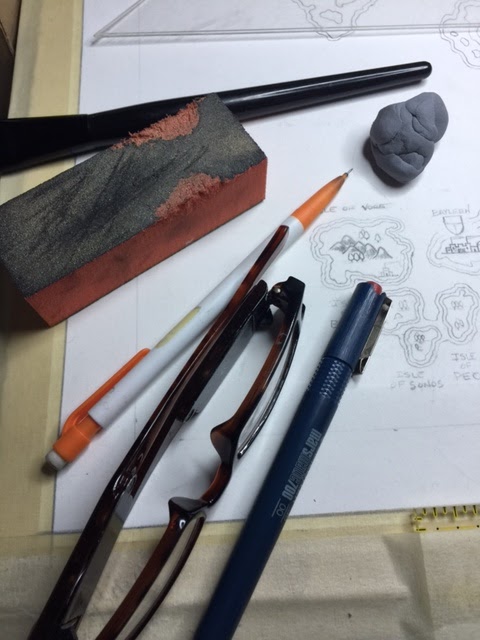
So I bought a book about drawing world maps, went to Michael's for supplies, taped paper to board, and set up my drawing area. It's kind of a daunting thing, once you realize you are in control of every aspect of this world. I was, and am, faced with filling this world with environmental details, civilizations, and a myriad of cultures.

Thankfully, I have friends that are into world building and will be helping me put together a rich world full of adventure. In the meantime, I have a lot of drawing, inking, and painting to accomplish. I'll be detailing the formation of our world here in this blog, so subscribe and keep up with how we are doing. It will also be sort of a sandbox world, where we can place our adventures as well as ideas and contributions from followers.

The world we are creating is called Halcyon. I've started a rough sketch of the continent and some of the details in the mountains, forests, kingdoms, and capitol cities.


A basic continent form surrounded by seas.


Details of the first kingdom. 

I'll try to post often as I get more of the world filled in. If you have ideas or want to share tips, feel free to leave a comment or email me at wayne@dungeoncrate.com. Feel free to also share images of the worlds you have created. 

Here's a fantastic map that's one of my friend PFloyd's favorites. He found it on a cartographer's guild page. I like the continent layout, but love the look and design. 


Thanks for reading. Let the adventure begin!


Braille D20 review by Chuck Winstead

Note from the editor: 
Chuck emailed me a while back asking about some of our Dungeon Crate items and the textures they have as he loves to play Dungeons and Dragons, but is blind. This was interesting to me as most of my early role-playing years, we relied on the storytelling to paint a picture in our mind's eye. Today, the game has evolved to incorporate terrain, a variety of dice, miniatures, and maps. All well and good if you can actually see them. 

Chuck's email got me thinking that there is an undeserved community of gamers that need some specialized accessories to complement their gaming. I started researching braille dice and found a Shapeways maker. I bought one and sent it to Chuck to test out and review. In the course of our communications, we brainstormed other ideas that would allow blind players to easily read their character sheets, keep track of hit points, and even a textured mapping system that could help better paint the picture. 

Chuck was kind enough to write a review of this particular die and we will be working together to find more items and develop others to cater to this demographic. Here are Chuck's thoughts on the braille D20 I sent him from Beckah DM's Shapeways site.  - Wayne Brekke 

 http://www.shapeways.com/shops/JGoldsmith


Disclaimer:
I have been doing Product testing from Dungeon Crate. Dungeon Crate has been graciously providing the products to review.

I have been playing Dungeons and Dragons for some time and have enjoyed playing. Since Dungeons and Dragons needs a set of gaming dice such as the D20, D8, D6, D4, D10, percentile D10, and D12, finding braille gaming dice is kind of hard.

It has not been until recently that braille dice have been made readily available, but thanks to lower prices on 3D printers and online outlets for makers to sell their wares, there are a few options. A few people have had Kick starters to fund producing them. It is nice to see this become a thing. In the past the choices have been to buy printed gaming dice and use a braille labeler to braille out the dice, which unfortunately may not be an option for everyone.

A description of the die:
The D20 is slightly larger than a normal golf ball. It still holds the same traditional shape of a D20 with the triangular faces. The only difference in this die compared to a normal printed die is that it is in braille.

Things I like about the die:
Recessed faces - Since the die is in braille, the face is recessed enough to have a raised edge. Kind of like a fence around the braille. This helps keep the die random, since each braille number will have certain dots in a certain pattern. Not having this could have affected the die when it is rolled.

I also like how the die is actually in braille - I have not really found many dice for Role Playing games in braille. You are easily able to find your D6 or six sided die in braille. However, many six sided dice has pips that you can feel. Role Playing games use more than just a D6. You can use an app, or have a sighted fellow gamer play tell you your number, but in some instances of role playing. You may not want to have someone know your dice roll, so having it in braille I find to be a nice and good thing.

Things that can be better:
These are not things I dislike, but more so things that could be better in my opinion. The die is a pretty solid and good die. It does what it needs too.

Adding some weight - While you’d think that with this die being slightly larger than a golf ball it would have a bit of weight, but it is very light. This isn’t a bad thing to an extent. I say that it could be better with some weight is because of when you roll it, the die will bounce and roll for a bit. Yes, dice do need to roll and that is what they do. Adding some weight to the die will allow it from bouncing and rolling off of the table.

Removing the triangle inside of each face - The die is a normal D20 die and has the triangular faces. Inside of each triangular face is a sub triangle so to speak. The reason I think it would be nice if it was not there is because it would have allowed more room for the braille, as some of the markings do seem confusing.

In short, braille 4, 6, and 8s all can look very similar. When the die is turned a certain way, the 8 may look like a 4 or a 6, same for the 4 and 6. If turned another way, it may look different.

Thankfully the die does have a few things there to help with that. The face where a six should be there is a braille cell of all six dots.

Clearer braille - While the die does have braille, I would have liked to see maybe a tactile line under 4, 6, and 8 to help make sense of each number.
While roman numerals are not very common in RPG dice, I think having this in this case would have also helped.

On the face where the 11 is, there is a series of dots that one would probably think it is an X. maybe having Roman numerals for the 5, and 10 would be helpful. 5s and 9s in braille like 4, 6, and 8. Depending on how they are turned it can look kind of confusing.

You can refer to the surrounding numbers to see what your actual result is, but having the clear braille would have made things that much easier.

While this die can be better, it is a great thing. I cannot weight to use it in more Dungeon and Dragons sessions in the future.